
From fake listings to AI-powered refund fraud and how ToothPic’s device and image fingerprinting solution helps restore trust
When a Photo Is No Longer Proof
In 2026, the old saying “seeing is believing” no longer applies to digital commerce. Product images have served as proof of authenticity, condition, and ownership across online marketplaces and e-commerce platforms. Today, that trust is rapidly eroding.
The rise of generative AI tools, such as ChatGPT, Google Gemini, Perplexity, has fundamentally changed how images are created and manipulated. Fraudsters can now generate hyper-realistic product photos in seconds: images of items that don’t exist, appear damaged, or look significantly different from reality.
According to the State of Refunds 2026 report by Ravelin, 65% of consumers say AI makes it easier to falsely claim refunds online, highlighting how generative AI tools are lowering the barrier to fraud, which reveals a startling “democratization of deception.”
At the same time, retailers are increasingly worried about AI-driven fraud:
- 91% of online merchants fear AI-powered fraud attacks.
- 76% of retailers report that fraud increased in 2025, with many pointing to customer-initiated fraud such as refund abuse and fake claims.
- AI-generated scams grew dramatically, with 62% more victims in 2025 compared to the previous year.
Generative AI is also making scams harder to detect. A research from Shift shows that 70% of consumers say scams are becoming more difficult to identify, as AI enables increasingly realistic digital deception and the consequences are already visible in the fraud statistics.
Fraud reports linked to AI-driven scams reached 444,000 cases in the UK alone in 2025, highlighting how artificial intelligence is accelerating large-scale online fraud.
At the same time, investigators have documented cases where scammers used AI-generated images of damaged products to obtain refunds, manipulating the visual evidence submitted to merchants. Without reliable image verification, platforms face three major risks:
- Loss of consumer trust
- Financial losses from fraud
- Reputation damage for marketplaces
To understand the scale of the challenge, it is important to look at two emerging fraud patterns:
- Fake listings powered by AI-generated images
- Refund abuse using manipulated product photos
Both are growing rapidly and both depend on the same vulnerability: the inability to verify whether an image is authentic.
Use Case 1: Fighting AI-Generated Fake Listings with ToothPic
Traditionally, listing fraud required scammers to steal product images from other websites but generative AI has dramatically simplified the process. Today, fraudsters can generate high-quality images of products that:
- Look completely realistic
- Match marketplace style and formats
- Appear professionally photographed
These AI-generated images are then used to create convincing listings. Once buyers pay for the product, the fraudster disappears or sends a package that is empty. Because the images appear authentic, victims often realize the fraud only after the transaction is completed. AI tools make this process faster, cheaper, and scalable, eroding platform confidence 37% now spot AI pics but still fall victim.
How ToothPic Can Stop Fake Product Listings
To combat this threat, marketplaces must shift from image analysis to image authentication.
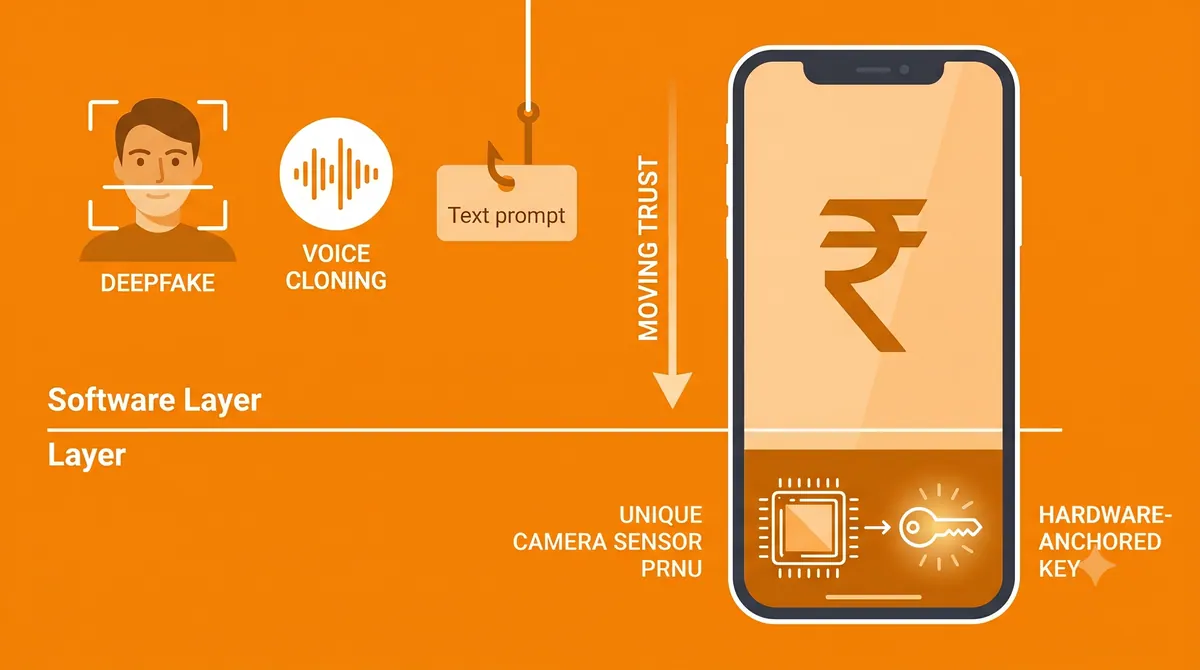
Instead of trusting any uploaded image file, platforms can require sellers to capture product photos directly through a secure camera interface integrated with ToothPic technology, that securely authenticate the image through a capability connected to the device camera fingerprinting feature.
Every smartphone camera sensor has microscopic, unique imperfections called Photo-Response Non-Uniformity (PRNU). These act as a “sensor fingerprint” that is impossible to replicate digitally.
ToothPic ensures that the photo was captured:
- by a real smartphone connected to a real user
- at that moment
- by a specific registered device
ToothPic stops these fakes before they are ever published. Unlike traditional AI detectors that try to guess if an image “looks” fake, ToothPic verifies the physical origin of the photo.
ToothPic’s process:
Enrollment: When a user registers, ToothPic securely records their device’s fingerprint.
Signing: When a user takes a photo for a listing, ToothPic’s technology “signs” the image with the sensor’s unique feature pattern.
Verification: the fingerprint is compared with the enrolled device signature.
If the fingerprints match, the platform can confirm that:
- the photo was captured by the registered device
- the image was not generated by AI
- the image was not downloaded from the internet
This approach transforms a simple photo into verifiable digital evidence that the product actually exists.
Use Case 2: Fighting AI-Powered Refund Fraud with ToothPic
Fraudsters buy legit items, then, once received, they take then AI-edit photos of those objects to show “broken” goods for refunds. Ravelin’s Jamie George highlights this in their 2026 report, with 25% of shoppers succeeding at 98% rate.
Customers may falsely claim that:
- a product arrived damaged
- the wrong item was delivered
- the product condition does not match the description
Researchers and fraud investigators have already documented cases where AI was used to generate fake product damage images in refund claims, leading to financial losses for merchants.
Fraud analysts report a 15% increase in AI-generated refund evidence since 2024, as scammers experiment with image-editing tools to fabricate claims. This creates a difficult challenge for customer support teams. Employees reviewing refund requests may only have seconds to evaluate an image. If the photo looks convincing, the refund is often approved. Fraudsters know this and exploit it.
How ToothPic Prevents AI-Driven Refund Fraud
Marketplaces often default to “the customer is always right” because they have no way to verify the evidence. ToothPic changes the power dynamic by turning evidence into unfalsifiable truth. ToothPic introduces a powerful concept: authenticating photos at the moment they are captured.
Instead of accepting uploaded images, platforms can require customers to capture evidence directly through the app.
This ensures that the image is:
- taken in real time
- captured by a verified device
- authenticated through the camera fingerprint trough ToothPic
If someone attempts to upload an AI-generated image or a manipulated photo, the system immediately detects the inconsistency.
The fingerprint embedded in the image will not match the device registered during enrollment. As a result, platforms can identify fraudulent claims before processing refunds.

The Financial Impact of AI Fraud on Marketplaces and E-commerce
Beyond operational complexity, AI-driven fraud is creating a measurable financial burden for marketplaces and e-commerce platforms.
Direct Financial Losses
- According to Juniper Research, e-commerce fraud losses are projected to reach $107 billion by 2029, driven by increasingly sophisticated AI-enabled attacks.
- Refund abuse alone accounts for a growing share of losses, with industry estimates suggesting it can represent up to 10–15% of total returns in some retail categories.
Operational and Hidden Costs
- Fraud management expenses including investigation, customer support, and dispute handling can increase operational costs by 20–30%, according to insights from Deloitte.
- Chargebacks not only result in lost revenue but also incur additional fees and penalties, further eroding margins.
A Growing Profitability Challenge
For marketplaces, AI-driven fraud is no longer just a security issue, it’s a profitability and growth constraint.
Unchecked fraud leads to:
- Lower margins due to refunds and chargebacks
- Higher customer acquisition costs to replace lost users
- Reduced platform liquidity as trust declines
As AI lowers the barrier to entry for fraudsters, the financial exposure will continue to grow unless platforms adopt stronger verification mechanisms.
Intangible Losses
AI-driven fraud erodes trust, damages reputation, and undermines customer loyalty. These intangible costs are harder to measure than direct financial losses but can be equally, if not more, damaging to marketplaces and e-commerce platforms.
- Decline in consumer confidence: Around 36% of retailers report lost income directly tied to decreasing customer trust as fraud rises. Shoppers become more cautious, delaying or abandoning purchases, which impacts revenue streams over time.
- Customer churn and loyalty erosion: Studies indicate 41% of consumers now approach online shopping with heightened scrutiny due to fraud concerns, and 22% have stopped shopping with a retailer after experiencing or hearing about fraudulent claims. This directly reduces repeat purchases and lifetime customer value.
- Brand and reputational damage: Beyond lost sales, AI-driven fraud harms the marketplace’s image. Customers and partners may question platform integrity, making it harder to attract new users or maintain existing partnerships.
Why Image Authentication Will Become Essential in the AI Era
Generative AI will continue to improve. Images generated by AI are already becoming indistinguishable from real photos. Humans struggle to differentiate between real and AI-generated images.
This means that manual review will not be enough to stop future fraud. Instead, digital commerce will increasingly require verifiable visual evidence. Just as identity verification became standard for online payments, image authentication may soon become standard for online transactions.
Technologies like ToothPic, based on camera fingerprinting can provide that missing layer of trust. By verifying the source of images, platforms can:
- detect fake listings
- prevent refund abuse
- reduce fraud costs
Most importantly, they can preserve something that generative AI is starting to erode: trust in what we see online.
By integrating ToothPic, companies can move away from reactive “cat-and-mouse” AI detection and toward a proactive, hardware-based security model.
If your marketplace or e-commerce platform relies on images as proof, it’s time to rethink how you verify them. Discover how ToothPic can help you prevent fraud, protect revenue, and restore trust in your platform.
Contact us