How ToothPic’s Smartphone-Based Authentication Solution Reduces E-Waste and Environmental Impact
As we mark the 56th Earth Day this Wednesday, April 22, 2026, the global dialogue is shifting. Under this year’s theme, “Our Power, Our Planet,” the focus has moved beyond traditional conservation toward the systemic changes required for a stable climate. While we often quantify environmental impact through plastic waste or vehicle emissions, a silent contributor to our global footprint is rapidly expanding: our digital trust infrastructure.
As societies become more dependent on digital services, the environmental impact of infrastructure such as data centers, networks, and cybersecurity systems is becoming impossible to ignore. This evolution introduces a new imperative: digital transformation must also be environmentally sustainable, especially now that AI is one of the most used tools in digital environments for both industries and users.
Moreover, we must focus on the technology that users interact with daily and that industries need to implement to keep the digital environment secure, such as the authentication solutions used to access banking services, healthcare, and public administration (PA) services. In this article, we will examine how the ToothPic solution helps the digital environment be more sustainable compared to other authentication solutions on the market.
Digital Sustainability: Focus on The AI Challenge
The push for digital transformation, accelerated by the explosion of Artificial Intelligence (AI), has brought a hidden environmental cost. By 2030, the electricity demand for AI-driven data centers is projected to be 11 times higher than 2023 levels. This surge isn’t just about power; it involves massive water consumption for cooling and a staggering increase in carbon emissions from the manufacturing of high-performance chips.
Digital sustainability, the intentional design of digital products to minimize their resource lifecycle, is now a core pillar of corporate responsibility. As organizations scale their AI capabilities, they must simultaneously look for ways to reduce the physical hardware footprint of their security systems. However, the environmental impact of AI is not limited to model training. It extends to continuous operations, including:
- Identity verification
- User authentication
- Secure access management
These processes occur billions of times per day, forming a hidden but significant layer of energy consumption.
Authentication: A Critical but Overlooked Sustainability Challenge
The Limitations of Hardware Token
Authentication systems are essential to digital trust, yet many existing solutions introduce structural inefficiencies from an environmental perspective.
For decades, high-security authentication has relied on physical hardware tokens. Hardware-based authentication relies on a linear lifecycle: production, distribution, usage, disposal. While effective at providing Multi-Factor Authentication (MFA), these “unconnected” devices carry a heavy environmental and administrative burden:
- The E-Waste Cycle: For a typical 100-employee company, organizations must purchase 50% extra keys annually due to employee churn. This constant cycle of manufacturing and disposal contributes to the world’s fastest-growing waste stream: e-waste. Global e-waste reached 62 million metric tons, with small electronic devices contributing significantly to this growth.
- The Logistics Carbon Footprint: Implementing hardware tokens involves an “eco-unfriendly” process where administrators must prepare keys for shipping and track logistics. This process typically takes one week and relies on shipping that produces additional environmental pollution.
- Inefficiency and Cost: Standard hardware tokens carry an annual Total Cost of Ownership (TCO) of $30–$60 per token. Total replacement and reset costs can reach up to to $120 per employee annually. Furthermore, 95% of employees find these physical tokens inconvenient from a user-experience perspective.
Comparison: ToothPic vs. Hardware Tokens
When we look at the lifecycle of a new employee setup, the contrast is stark.
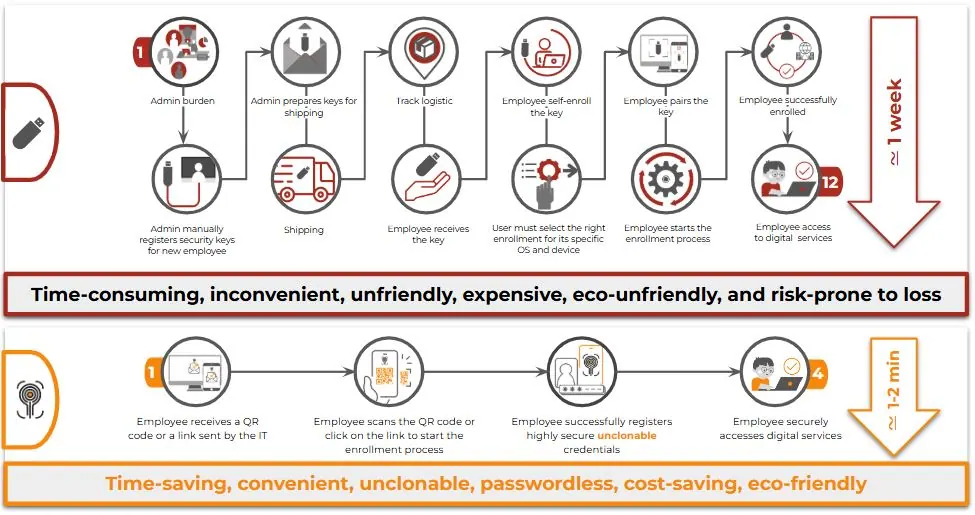
As illustrated in the provided analysis of Hardware Token vs. ToothPic, the traditional hardware approach is a multi-step, resource-intensive process. It requires the physical manufacture of plastic and electronic components, followed by the logistical energy consumption of global shipping to get the token into the employee’s hands. Once the employee leaves the company or loses the device, the token is frequently discarded, adding to the toxic e-waste stream.
ToothPic, by contrast, operates on a Circular Digital Model. It leverages the smartphone hardware that the user already possesses. There is:
- Zero Manufacturing: No new plastic, copper, or rare earth minerals are required.
- Zero Shipping: The “delivery” is a secure digital transmission, eliminating carbon emissions from logistics.
- Zero Disposal: Because there is no physical device provided by the company, there is no physical waste generated when an employee leaves.
By eliminating the hardware, ToothPic shortens the entire enrollment workflow from a week-long logistical burden to a 1-2 minutes secure digital process. This isn’t just a gain in user experience; it is a measurable reduction in the corporate carbon footprint.
The Limitations of SMS and OTP
Other methods such as SMS and One-Time Passwords (OTP), while appearing more sustainable because they lack a physical token, present their own challenges. These solutions rely heavily on telecom and cloud infrastructure. The GSMA estimates that the telecom sector contributes 2–3% of global greenhouse gas emissions, reflecting the cost of maintaining global connectivity.
While individual authentication events may seem negligible, their cumulative impact is substantial:
- Billions of transactions per day
- Continuous server processing
- Persistent network usage
This results in a distributed but significant carbon footprint.
ToothPic offers a radically different paradigm by leveraging the hardware users already own: the smartphone.
The Technical Edge: How ToothPic Technology Works
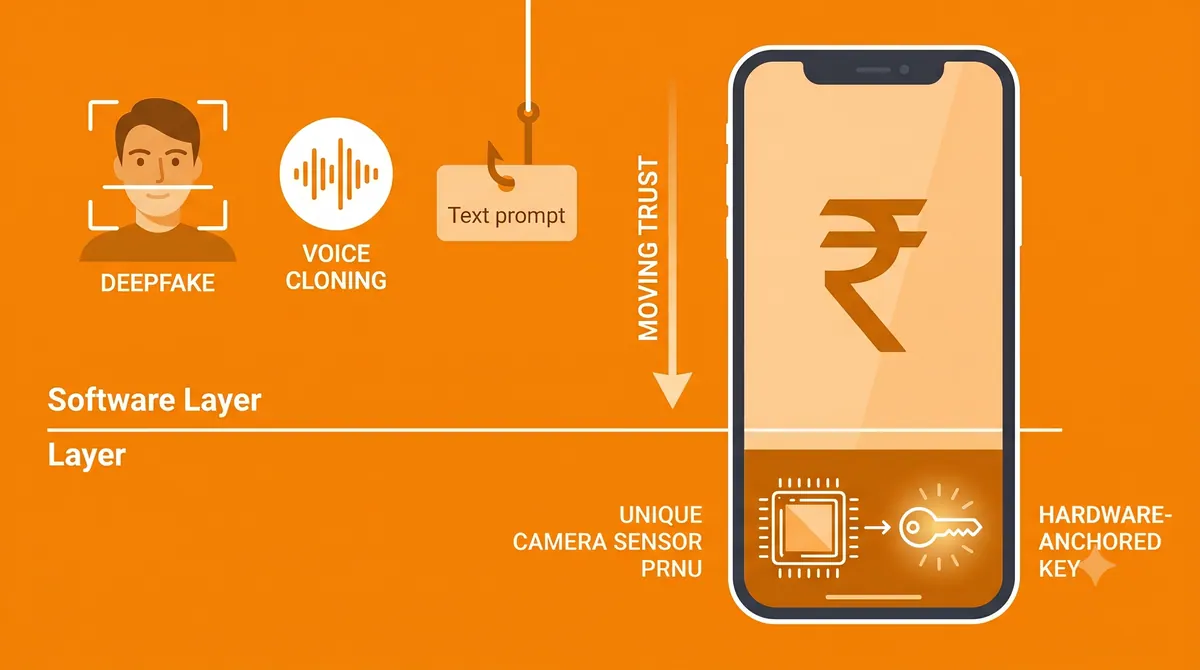
ToothPic does not rely on traditional “optics” or visual data, meaning scratched or broken glass does not interfere with its performance. Instead, it uses a sophisticated algorithm to detect the unique pattern of slight differences in the way each photodetector (pixel) on a smartphone’s image sensor converts photons into electrons.
The Technology in Action:
- Sensor Fingerprinting: The system detects microscopic manufacturing variations in the image sensor.
- Raw Data Transformation: The ToothPic algorithm combines image processing, channel coding, and cryptography to turn this massive amount of raw data into an unclonable private key in fractions of a second.
- Privacy-First Design: Visual content is removed from pictures during processing, ensuring that users’ privacy is preserved as no actual images are stored or transmitted.
- Zero-Waste Lifecycle: Because ToothPic uses existing sensors, it requires no extra hardware, eliminates delivery costs, and requires no physical IT support.
ToothPic introduces a new model based on a simple but powerful principle: use what already exists instead of creating new hardware.
The solution transforms smartphones into secure authentication devices by leveraging the unique characteristics of their camera sensors.
Each sensor contains microscopic variations that act as an unclonable digital fingerprint, enabling:
- Strong authentication
- Passwordless experiences
- Hardware-free deployment
This approach eliminates entire layers of environmental impact:
- No manufacturing
- No shipping
- No physical maintenance
- No disposal
Alignment with the EU Green Deal
In alignment with the EU’s Green Deal, ToothPic offers a significantly more environmentally sustainable alternative to existing high-security solutions. The widespread adoption of this software-based solution will eliminate the need for the manufacturing, distribution, and eventual disposal of millions of plastic and electronic hardware tokens.
This directly supports UN Sustainable Development Goal (SDG) 8 Target 8.4 by improving global resource efficiency in consumption and production. Ultimately, an investment in ToothPic is an investment in the foundational trust infrastructure required for the entire EU Digital Single Market to thrive in the AI era.
Alignment with the EU Green Deal
This Earth Day, organizations have the opportunity to prove that security and sustainability are not mutually exclusive. By moving away from disposable plastic tokens and energy-intensive legacy methods, companies can reduce their administrative burden while actively contributing to a zero-waste future.
Choosing ToothPic is a commitment to protecting both our digital identities and the only planet.
Contact us